EdTech|
Canada|
HCE

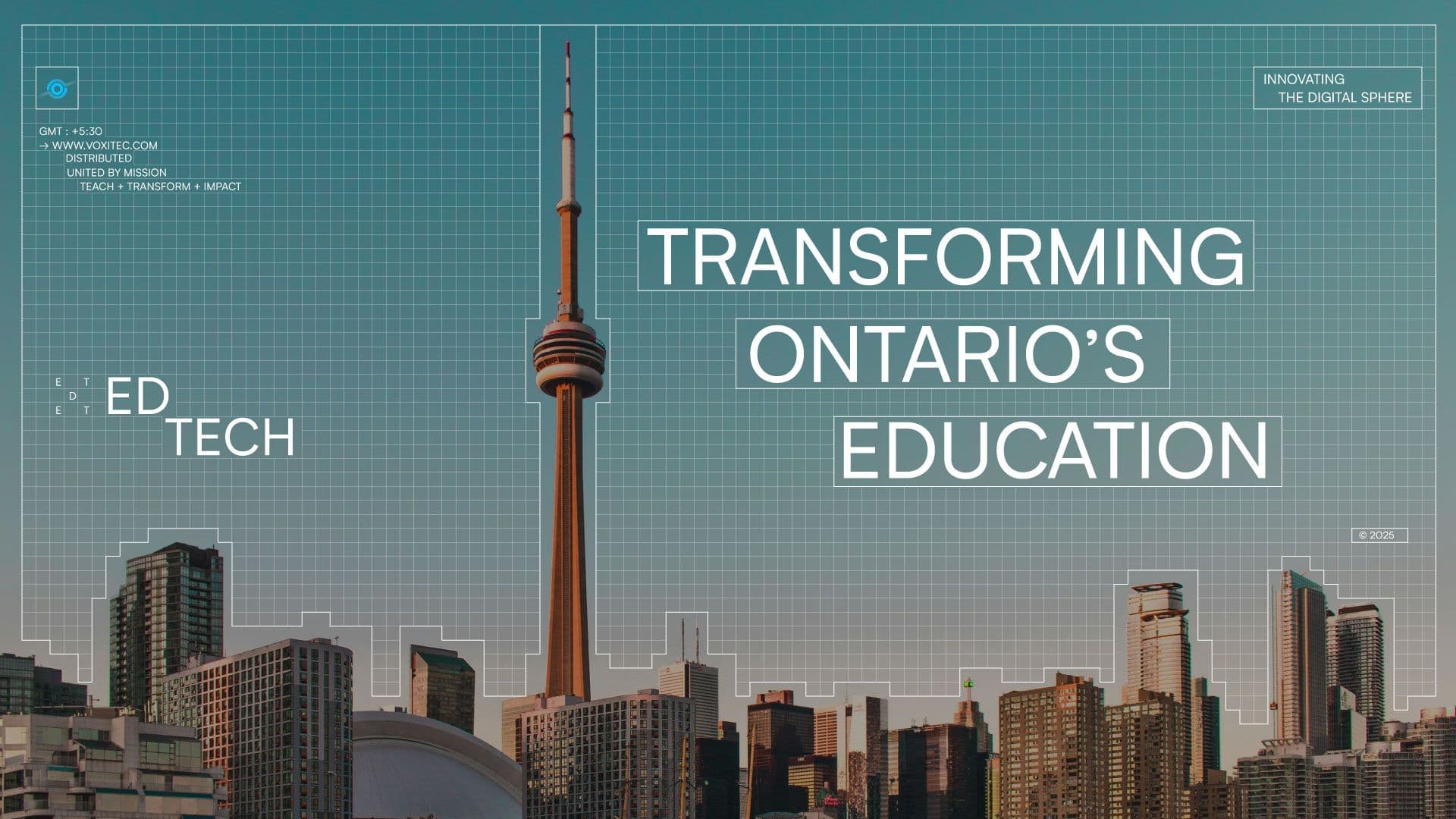
Transforming Ontario’s Education Revolution Through Technology

Vivienne Griffith

November 11, 2025

Transforming Ontario’s Education Revolution Through Technology

Why Ontario Needs an Education Revolution 

The phrase “Education Revolution” suggests something more than incremental change—it implies a fundamental, systemic transformation in how teaching and learning occur. In Ontario, the Education Revolution reflects a shift from traditional, classroom-centric models to a technology-enabled, learner-centered ecosystem. Fueled by pandemic disruption, surging student and educator demand for flexibility, and global digital innovation, Ontario now stands at a crossroads. The question is not whether to adopt technology, but how to do so equitably, sustainably, and aligned with the province’s educational mission. This article maps the historical journey, current landscape, obstacles, and strategic roadmap for realizing a true digital education revolution across K–12, post-secondary, and vocational sectors.

Historical Context: Ontario’s Education Before Digital Transformation

Ontario’s public education system has a long tradition of classroom-based instruction, where “face to face learning” was the norm, and textbooks and lectures were the primary focus of lessons with standardized assessments. Before the shift to digital tools, computers were typically limited to labs and were not fully integrated into daily learning. Technology played a supporting role, along with projectors and SmartBoards.

In the early 2000s, the province introduced the Ontario Educational Resource Bank (OERB), a repository of curriculum-aligned digital resources (interactive lessons, worksheets) accessible to teachers and students. According to People for Education (2025), e-learning courses were piloted to supplement offerings, especially in smaller boards. However, uptake was uneven, infrastructure varied, and many schools remained reliant on textbook-based instruction. The digital presence was incremental rather than systemic.

Ontario’s first coordinated step into digital education began in 2006 with the launch of the provincial e-learning strategy, which aimed to expand course access, especially for rural and remote students. This initiative was among the earliest provincial efforts in Canada to integrate online learning into secondary schools. Through the 2010s, some boards began blended or flipped classroom models, and post-secondary institutions offered online courses. But these remained supplementary rather than foundational. The system lacked unified strategy, robust infrastructure in underserved areas, and consistent professional development for teachers in tech pedagogy.

Investments included digital course content, a province-wide learning management system, and teacher training. However, despite these efforts, “uptake remained relatively modest” as many schools continued to rely heavily on traditional in-person models. These early digital initiatives created a foundation that later supported Ontario’s accelerated adoption of online learning during the pandemic.

Key Drivers of Tech-Driven Education in Ontario

Ontario’s education sector is currently speeding up its adoption of digital technology due to five transformative movements.

The first movement was the Pandemic and the acceleration of digital equity gaps. The abrupt shift to remote learning "brought forth the digital equity gaps within each school," demonstrating that while learning models could be delivered asynchronously and synchronously, significant disparities existed in access and support as stated within People for Education, 2025. This experience emphasized the critical need for flexibility and accommodation in learning expectations, spurring the development of self-paced courses and hybrid options to ensure students who required diverse support could remain actively involved in their education.

Second, the changing job market requires updated technical skills. To keep up with the evolving economy, the Higher Education Quality Council of Ontario now emphasizes that new graduates need updated technical skills. According to the "Future of Skills Report" published in 2025, new graduates must be "highly proficient in core digital literacy and applied computational thinking" to meet the demands of the modern workforce Future of Skills Report, 2025. This major shift toward essential digital know-how is now "forcing institutions to offer agile, modular, and industry-relevant training, including verified micro-credentials" Future of Skills Report, 2025, thereby requiring schools to adopt continuous learning models and short, focused courses that teach immediately applicable skills.

Third, the need for system consistency and centralized content is a major factor. The province is driving digital consistency across school boards by prioritizing shared digital platforms and centralized content. This standardization allows for economical, system-wide updates to the curriculum, lowers the overall cost of upgrades, and guides system-wide improvements in pedagogical delivery and resource quality.

Fourth, Global Education Technology forces Ontario to remain competitive in the digital education sector. International innovations in AI-adaptive learning, digital educational games, and advanced analytics—which include tracking student participation, assessments, identifying at-risk learners, and supplementing teaching methods—work together to provide high-quality individualized instruction  noted Nucamp, 2025. This global pressure ensures that Ontario's system strives for cutting-edge, personalized learning experiences.

Finally, the continuous transition to post-secondary education creates a demand for seamless alignment. The consistent high rate of students transitioning into university or college within seven years of finishing high school (75.8%) means the K–12 system must align its digital output and student readiness with the needs of higher education, where 77% of institutions plan to expand partially online (blended/hybrid) courses to meet student flexibility demands eCampusOntario, 2025. This drive for alignment reinforces the urgency for digital technology within the classroom, creating a new education revolution.

How Voxitec Supports the Digital Transformation of Education in Ontario

As a mission-driven company, we collaborate with school boards, government ministries, teachers, and education experts to co-design digital solutions that reflect local values and inclusivity. Rather than promoting generic software, we develop customized systems aligned with Ontario’s curriculum and accessibility standards, ensuring that all students, including those in rural or underserved areas, benefit equally. Our approach creates a sustainable and equitable path toward digital transformation. It strengthens institutional capacity, balances innovation with equity, and supports Ontario’s long-term vision of an adaptive, technology-driven education system.

The true value of the technical solutions we develop lies in how they empower institutions to scale learning with confidence, enabling real-time collaboration, robust data security, and seamless content delivery across Ontario’s diverse educational landscape. From AI-driven adaptive engines to automated grading systems, these innovations not only support individual learners but also anticipate educational needs, allowing teachers to focus more on the art of teaching. At the institutional level, integrated management systems and unified analytics foster transparency and agility in modern education governance. As legacy systems evolve into secure, cloud-based ecosystems, administrative work becomes simpler, decisions clearer, and outcomes more meaningful—effectively addressing the challenges facing today’s education system.

Every decision at Voxitec is guided by three major principles.

  1. The first principle is accessibility and equity, ensuring that our technological solutions are easy to use and available to every student, regardless of their learning needs or location. Accessibility removes barriers so that all learners can benefit from digital tools, while equity ensures that students in every school, whether urban or rural, have access to the same high-quality educational opportunities.

  2. The second principle is the integration of artificial intelligence (AI) and personalized (adaptive) learning. These innovations enable instruction to be tailored to each student’s individual needs. Adaptive learning platforms automatically assess a learner’s strengths and weaknesses, helping teachers provide targeted support that enhances engagement and achievement.

  3. The third principle is security and privacy, ensuring that all student data and records are managed with the highest level of protection. It follows a framework that embeds data protection and ethical standards into every stage of digital implementation—from classroom tools to system-wide platforms. Supported by Ontario’s strong data protection laws, this approach ensures that digital learning environments remain safe, ethical, and trustworthy for both students and educators.

Through close collaboration with educational partners and local communities, we develop solutions that reflect Ontario’s curriculum priorities and community values. This inclusive and innovative approach ensures that technology benefits everyone and supports the province’s vision of an adaptive, student-centered education system.

Government Policies and Supports 

Based on the Ministry  of Education's 2023-2024 published plans, the provincial government uses multiple channels to support digital learning. The most explicit policy is the Policy/Program Memorandum (PPM) 167, issued in February 2022 by ONTARIO.CA, which states that students must earn “two online learning credits” to obtain their Ontario Secondary School Diploma (OSSD). This requirement builds digital literacy for post-secondary and workforce preparedness in students. However, students and their parents may opt-out of the online learning credits by filling in an online form and submitting it directly to the board and may still graduate to obtain their OSSD.

The Ministry funds the Ontario Educational Communications Authority (TVO), which, through its TVO Digital Learning and Independent Learning Centre, provides curriculum-aligned online learning courses and resources for K-12 students. These are supplements to the in-class curriculum that is taught each day.  Furthermore, while eCampusOntario is an MCU initiative, the Ministry tracks and aims to increase student participation in job skills programs like Dual Credit (which promotes co-operative on-the-job learning) to move higher than the 47% of students who participated in the program in 2021, according to OnSIS (Ontario School Information System), with additional funding committed in the 2025 Ontario Budget to expand healthcare and apprenticeship-related courses, often delivered in a blended or digital format.  “Grants for Student Needs (GSN) and Priorities and Partnerships Funding (PPF) “also provide financial support to boards for developing online learning capacity noted in eCampusOntario.

Technology and Pedagogies Reshaping Learning 

The Education Revolution is reshaping learning by integrating technology and modern pedagogies to create flexible, personalized experiences.

The most critical tool is AI for personalization and adaptive learning. Instead of uniform teaching, this approach is lauded for ensuring "instruction is tailored precisely to individual knowledge gaps Ministry of Education, 2024. For example, an "AI Math Coach," modeled after systems like "Delta Math" in high schools and "Knowledge Hook" in elementary schools, can instantly assess a student's grasp of a topic (like solving for x). It provides tailored resources, aligning with the Ontario curriculum's focus on individualized pacing and achieving mastery.

Furthermore, technology boosts engagement and skill development. Gamification makes abstract lessons fun, while flipped/blended learning moves instruction (videos) outside the classroom. This frees up class time for debate and collaborative projects, building "crucial critical thinking and communication skills necessary for future careers Skills Canada Report, 2023. Finally, learning analytics provide data to teachers, allowing them to pinpoint and fix confusing curriculum sections, guaranteeing the system constantly improves for all students. 

Equity, Access, and Infrastructure Challenges 

The shift to technology-driven education in Ontario faces significant hurdles related to Equity, access, and infrastructure. One of the largest challenges is the rural broadband gap. Many students and teachers in remote communities still struggle with reliable, high-speed connections. One report noted that "Reliable high-speed internet remains a mirage for many northern and remote Ontario schools, hindering consistent access to cloud-based learning  Digital Equity Report, 2023. This gap makes mandatory online learning unfair.

Beyond infrastructure, issues of equity persist with device access and digital literacy gaps. Not all students have the necessary high-quality devices at home, and many lack the skills to use complex digital tools effectively. A study highlighted the "inconsistent baseline digital skills among students, especially in lower-income areas" as noted in Ontario Teacher Needs Study, 2024.

Finally, language inclusivity and special-needs accommodations must be prioritized. Digital resources must be fully available in both English and French, and platforms require advanced accessibility features (like screen readers and voice commands) to ensure students with disabilities are not left behind in the move toward digital classrooms. Successfully transforming education for students requires resolving these foundational access and literacy issues first.

Teacher Preparation, Professional Development and Institutional Capacity

The biggest hurdle in the digital shift isn't the technology itself, but ensuring teacher readiness and institutional support. Much of the current digital training is voluntary Professional Development (PD), which directly conflicts with heavy faculty workload, creating inconsistent digital skills for teachers. Teachers often find it difficult to complete this uncompensated training because, as one study noted, mandatory online development "often falls outside of paid working hours, limiting teacher participation and buy-in Ontario Teacher Survey, 2023.

To overcome this, institutions must prioritize building institutional capacity through funded training and microcredentials. Microcredentials are short, paid certifications that formally recognize a teacher’s expertise in new digital tools or teaching methods, making the time investment worthwhile.

Best-practice models show this approach works. Programs supported by organizations like eCampusOntario, such as the CDLRA (Collaborative Digital Learning Resource Adaptability) pilot, offer structured, integrated training. An analysis highlighted that such targeted efforts are key to "building consistent digital fluency across all disciplines and institutions eCampusOntario Analysis, 2024. Ultimately, investing in accessible, valued, and mandatory training is the only way to ensure every teacher benefits from digital learning.

Public-Private Partnerships, Funding and Governance

The move to digital learning requires huge amounts of money and expertise, which is why Public-Private Partnerships (PPPs) are essential. These partnerships involve the government working with private EdTech partners to quickly deliver the services needed. This model is critical because, as one provincial analysis noted, "The scale of technological infrastructure required exceeds the capacity of public budgets alone"  as stated in Ontario Funding Outlook.

The provincial goal of switching to a digital education system is tough because of several major roadblocks. Schools also need software that is customized to fit the exact lessons they teach, and it all has to be affordable, especially for smaller, rural school boards.

The government secures necessary funds through grants and special programs, such as  the Federal Development Ontario or other provincial funding opportunities. This money is used to acquire software and train teachers. Education Technology partners then play a crucial role by providing specialized, ready-to-use learning platforms and tools.

However, introducing private companies and large data systems into schools creates a massive need for data governance frameworks. These frameworks are the strict rules for keeping all student information private and secure. A key principle is that all partners must ensure "student data privacy is non-negotiable and protected by rigorous provincial standards Data Security Review, 2023. Without strong governance, the risks would outweigh the benefits. Ultimately, successful governance "builds trusting relationships among parents and the community," ensuring the revolution is ethical and secure states Edtech Digest 2025.

Risks, Ethics and Privacy

While technology makes learning easier, it creates big risks around the student’s privacy. Every digital platform collects student data, from test scores to login habits. Experts state the schools must implement systems where “student data sovereignty remains entirely with the individual and their guardian”  as stated within EdTech Magazine. In addition, “15 % of Ontario students surveyed  felt they had full control over how their data was used by learning platforms”details Ontario Student Trust Index, 2025.

The newest security challenge involves securing non-human identities. This refers to all the system accounts, AI bots, and shared classroom devices that access the school network. These are often high risk targets. A recent report warned that “a major vulnerability in K-12 systems is the compromise of device and system accounts, allowing backdoor access to student files” noted by Ed Tech Security Report. This shows that protecting the student (human) requires securing the technology (non-human). 

Ultimately, the use of AI creates conflict with academic integrity. Schools use software for cheating detection, which often requires intrusive monitoring of assignments, tests and exams. This raises the ethical question of the privacy trade-off. Student Well-Being Studies report that 65% of students experience “high levels of anxiety and distrust when required to use remote proctoring software that monitors their home environment and has the possibility of false flagging their work submitted” details Digital Ethics in Education Survey.

Exemplars and Case Snapshots

TVO Learn is a prime example of how digital platforms can support education effectively. It is a free digital learning environment that is aligned with Ontario’s K–12 curriculum. This platform offers a wide range of resources, including videos, lessons, and activities, which are accessible to students and teachers across Ontario. One of the key features of TVO Learn is its dedication to accessibility, meaning it is designed to be usable by students with disabilities. 

For example, it provides captions for videos and screen reader compatibility, ensuring that all students can benefit from its resources. This commitment to equitable design is ongoing, as one recent organizational update confirms: “We remain dedicated to removing barriers and providing equal opportunities for individuals with disabilities to engage with our content and services” as stated within TVO Media Education Group. 

Furthermore, the quality assurance process is rigorous, with TVO noting that "all resources have been reviewed for equity, inclusion, and accessibility and all Indigenous content reviewed by an Indigenous Education Expert” as commented within TVO Learn. This demonstrates how digital tools like TVO Learn are being leveraged to make education more inclusive and flexible across the province.

Another important development is the significant financial commitment made to Ontario’s post-secondary institutions, with substantial investment allocated for 2024–2025. Universities and colleges in Ontario have been the beneficiaries of government efforts to stabilize and modernize the sector. As one report on the funding notes, "The Ontario government introduced a suite of measures to stabilize the province's colleges and universities, including nearly $1.3 billion in new funding" in the Capital Hill Group. These investments often target critical areas like digital infrastructure upgrades, faculty training in new modalities, and enhanced student support services for virtual environments.

 For instance, funding has been earmarked for "capital repairs and equipment" as well as for the "infrastructure refresh of Ontario's Advanced Research Computing systems" as stated by the Capital Hill Group, This financial shift not only ensures the continuity of quality education but also solidifies the permanent digital transformation of the higher education landscape.

Furthermore, recent reports from the Canadian Digital Learning Research Association (CDLRA) indicate that many Ontario post-secondary institutions plan to keep or expand their use of hybrid and online learning modes. This shift is now viewed as necessary to meet evolving student needs. The latest survey data from the sector indicates that 77% of respondents "anticipate more courses and/or programs being offered in a partially online format for example blended/hybrid format” over the next two years stated eCampusOntario. 

Institutions recognize that students prefer this flexibility for pragmatic reasons, including the need to “manage competing priorities, cost savings, an inability to find affordable housing near campus, and an inability to access” resources  found by Canadian Digital Learning Research Association. These trends suggest that the digital shift in education is now considered irreversible, with institutions viewing digital learning as a strategic way to reach more students and provide flexible options.

Overall, these case snapshots demonstrate both what is possible with technology in education and how institutions are actively working to implement and expand digital learning. Their sustained efforts, supported by recent provincial funding and driven by student demand for flexibility, show a clear commitment to equity and innovation, which are vital in preparing students for the future. As the education landscape continues to evolve, the examples of TVO Learn, the stabilization investments in post-secondary institutions, and the ongoing development of hybrid learning models demonstrate that adaptation is already underway and will likely continue.

Recommendations and Roadmap

A staged approach to implementing educational technology is essential to ensure that efforts are aligned with the broader mission of equity and scalability. This method involves careful planning over short, medium, and long-term periods, allowing for continuous assessment and improvement. As one school board plan confirms, a commitment must be made to "identifying, removing, and preventing barriers that create disproportionate outcomes for underserved students" states the Toronto District School Board. By starting with short-term initiatives, districts can build on successes while addressing immediate needs. For example, launching pilot programs in underserved districts allows for testing new tools and approaches in real classrooms. These pilots can highlight effective strategies that should be expanded later.

In the short term (0–12 months), it is recommended that government and school boards focus on launching pilot programs specifically in underserved districts and schools. This targeted approach helps address disparities so that students in rural or low-income areas are not left behind. Additionally, allocating dedicated funding for rural broadband and device distribution is critical, as many rural areas lack reliable internet access. 

For instance, the Ontario government has “committed nearly $4 billion to bring access to reliable, high-speed internet to unserved and underserved communities across the province by the end of 2025” states Infrastructure Ontario. Moreover, providing teachers with release time and paid professional development (PD) allows educators to explore and experiment with new technologies, fostering innovation. Establishing ethics and data governance committees at the board and provincial levels ensures that student privacy, data security, and ethical standards are upheld as digital tools are integrated.

Moving into the medium-term (1–3 years), the focus shifts towards scaling successfully tested pilot projects across entire districts. This allows positive outcomes to benefit more students and teachers while ensuring consistency. Developing and curating high-quality, curriculum-aligned digital content is also essential because digital resources should complement and enhance classroom learning, not replace traditional teaching. 

Embedding microcredential programs into teacher training creates ongoing opportunities for educators to develop digital skills, keeping pace with technological advancements; for example, Ontario has already expanded OSAP eligibility to include students in “more than 1,900 eligible micro-credentials programs at both public and private institutions” states the Ministry of Colleges and Universities. Additionally, standardizing policies related to privacy, interoperability, and accessibility prevents fragmentation and ensures that digital tools work seamlessly and inclusively across systems. In fact, large institutions are already making this shift, aiming to "enhance accessibility by providing UX designers with a set of design guidelines, standards and reusable components" noted the University of Toronto.

In the long-term (3–7 years+), the goal is to leverage emerging technologies like artificial intelligence (AI) to personalize learning experiences. For example, AI-powered platforms can adapt lessons in real-time to meet individual student needs, promoting better learning outcomes. This trend is already established, as “personalized learning platforms and intelligent tutoring systems tailor content and pacing” in classrooms and on campuses across the country noted by Nucamp. Continuous evaluation through longitudinal studies is necessary to measure progress in learning gains, retention, and equity to ensure that technological advancements do not widen disparities. Furthermore, expanding lifelong learning pathways, such as seamless transitions between K–12 education, college, and industry certifications, can help students adapt to the rapidly changing workforce. Sustaining collaboration between the public and private sectors promotes ongoing innovation while safeguarding the core pedagogical goals of education.

By adopting this phased and comprehensive approach, Ontario can develop a resilient, equitable, and innovative educational system. Each stage builds on the previous one, creating a roadmap that aligns with the long-term goal of providing inclusive and effective education for all learners.

Conclusion 

Ontario’s Education Revolution is not a distant vision; it is underway and must be guided with intention, care, and justice. The pandemic revealed both the fragility and potential of our education system. Technology can catalyze more personalized, flexible, and inclusive learning, but only if aligned with curriculum, empowered teachers, and equity-first policy.  

As practitioner M. Griffith (2025) points out, "As an individual who works within the education system and with families outside the school system, the evidence is clear that students rely heavily on technology to support their learning. The difficulty with this is the dependence on AI technology. If AI is not present, they rely on teachers to deliver clear and precise instructions to assist them in completing assignments.

Research within textbooks is limited and most students rely on the World Wide Web to deliver the information they require for data. They also depend on the teachers to post assignments online, in addition to recovering information from the teachers through online learning because they have forgotten what they need once they have arrived home from school." Stakeholders, government, educators, and communities must commit to piloting, measuring, and iterating to keep pace with rapid change. Indeed, experts emphasize that for Canada to lead, we must "align our systems to meet this moment with urgency and ambition" noted in RBC.

This urgency is especially critical in the face of rising student reliance on new tools; as one study notes, “73 per cent of Canadian students now rely on generative artificial intelligence (AI) for their schoolwork”  as stated within KPMG Canada. This underscores the immediate need for clear educational frameworks and policies.

I invite your feedback as we are inviting education experts, board leaders, ministry officials, and practitioners from diverse fields and cultures to join our Advisory Council, helping to advance the acceleration of educational technology worldwide. We invite you to lend your valuable perspective and help us accelerate educational technology worldwide.


Similar Articles

Why Human-in-the-Loop is the Foundation of Responsible AI Systems

AI | HCE

Why Human-in-the-Loop is the Foundation of Responsible AI Systems

JOIN
OUR NEWSLETTER